
National Mental Health & Wellbeing at Work Show
Speaker Spotlight
$27.2 Billion and Counting: Why Australia’s Workplaces Cannot Afford to Wait
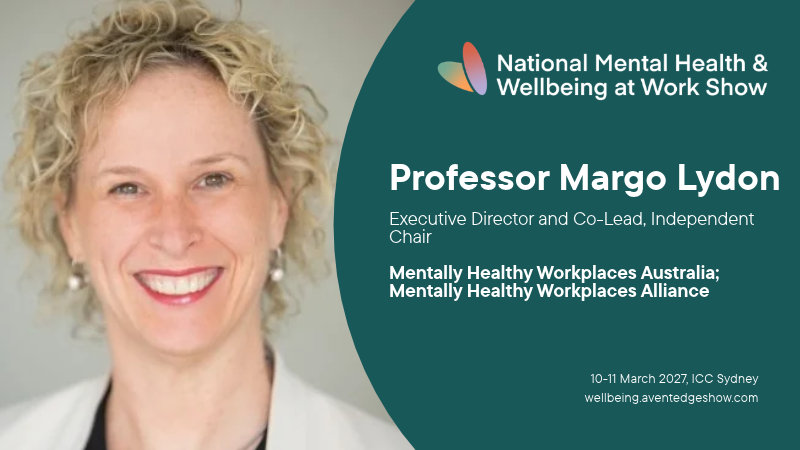
Professor Margo Lydon, Executive Director of Mentally Healthy Workplaces Australia, on the economic case for prevention, what good practice actually looks like, and why the future of work depends on getting this right.
Workplace mental ill-health cost the Australian economy $12 billion in 2025-26. On current trends, that figure rises to $27.2 billion by 2041-42. Behind every statistic is a person, a family, and a workplace bearing costs that don’t have to exist.
Professor Margo Lydon has spent 16 years working to change that. As Executive Director and Co-Lead of Mentally Healthy Workplaces Australia (MHWA) and Chair of the Mentally Healthy Workplace Alliance, she is building the national coordinated response Australia has long needed. In March 2027, she brings that message to the National Mental Health & Wellbeing at Work Show in Sydney.
We sat down with Margo ahead of her session to hear what the data is telling us, what good practice actually looks like, and why she believes the trajectory can be changed.
You have spent 16 years in this space. What keeps you going?
Margo’s path into workplace mental health began at the other end of the system. “I spent a decade working in support of people living with eating disorders,” she says. “That work showed me the human cost of mental and physical ill-health, and how truly remarkable the human spirit is, even when so incredibly challenged.”
That experience shaped everything that followed. When the chance came to move into prevention-led work, she took it. As CEO of SuperFriend, her team created the Indicators of a Thriving Workplace survey. She helped inform the Productivity Commission’s Inquiry into Mental Health. Now, through MHWA, she is building something bigger.
“Work can harm people,” she says. “Yet it can also be one of the most wellbeing-generating parts of people’s lives. MHWA is the chance to build a nationally coordinated approach to creating mentally healthy and safe workplaces for all Australians. After 16 years in this space, Australia needs a new approach, and MHWA fills that gap.”
What is MHWA, and why does it exist?
MHWA is a consortium of industry, unions, governments, regulators, insurers, technologists, service providers, investors and researchers, convened by Monash University. Its purpose is national coordination.
“Despite increased focus, legislation and effort, Australia lacks a coordinated and effective response,” Margo explains. “Evidence sits in one place and practice in another. Costs move between employers, insurers, governments and families without ever decreasing.”
MHWA’s first projects tackle problems every employer will recognise: making psychosocial risk easier for small and medium businesses to manage, building manager capability, and putting the best evidence in one practical place.
The numbers are stark. What does the data tell us?
MHWA’s report, Australia’s Economic Case for Mentally Healthy and Safe Workplaces, puts the scale of the challenge in sharp relief. Serious mental health claims have grown by more than 10.6% per year since 2018-19. Mental health conditions now account for an estimated 25.5% of all weeks lost to workplace injury and illness, up from 21.0% in 2018-19. Lost productivity alone costs Australian employers around $6.5 billion a year.
“The trajectory of rising harms and costs can be bent,” Margo says. “But only if we stop shifting the cost and start preventing the harm.”
She draws a compelling parallel with road safety. Since Australia’s first national road safety strategy in 1992, coordinated action has cut road deaths per head of population by 60%. “The same long-term, nationally coordinated and prevention-led approach can work in our workplaces,” she says.
If the change modelled in MHWA’s report is achieved, Australia avoids more than 291,000 serious mental health claims by 2041-42, and GDP is cumulatively $28.3 billion higher.
Where are the biggest gaps right now?
“The biggest gap is between knowing and doing,” Margo says. “Awareness of psychosocial risk has grown. Far fewer organisations have changed how work is actually designed.”
Too much effort still sits at the individual end: an EAP, a resilience session, a wellbeing week. “These have a place, but they can’t fix unmanageable workloads, poor role clarity or harmful behaviour.”
She points to a standout example of genuine prevention in action: the production team behind My Brilliant Career, Netflix’s new Australian series, supported by ScreenWell. They assessed psychosocial hazards before filming, trained people at every level, and surveyed cast and crew throughout. When morale dropped late in production, they moved a location shoot into a studio at significant cost. “That’s prevention,” Margo says simply.
What advice do you have for HR leaders who want to make a genuine difference?
Margo’s answer is direct: start with the work, not a wellbeing program.
Listen first. Ask your people what makes work harder than it needs to be. Then look at the data you already hold: leave, turnover, claims, complaints and survey results.
From there, find the hazards at the source. Workload, role clarity, support and behaviour are where harm often begins. Equip your managers, because they shape the daily experience of work more than any policy. Measure and adjust. And build the business case.
“The average workers compensation premium rate rose from 1.34% to 1.59% of payroll between 2021-22 and 2023-24,” she notes. “Couple the data with stories of impact to show it can be done.”
Her final piece of advice: don’t go it alone. “The organisations making real progress are learning from each other. This is also where conferences like this one can be super helpful.”
How is leadership changing in this space?
“Leadership is moving from sponsorship to accountability,” Margo says. “Not long ago, a supportive CEO message and a wellbeing calendar were seen as leadership. Today, psychosocial risk sits alongside physical risk as a work health and safety duty. That makes it a board and executive issue, with real financial and governance consequences.”
The most effective leaders she sees treat workplace mental health as core business, make structural decisions about how work is designed, ask their people, act on what they hear, and invest in their managers.
“Lost productivity makes up around 54% of the cost of workplace-driven mental ill-health. Leaders who get this right protect their people and their performance at the same time.”
What does the future look like?
Margo’s vision is clear. “A future where harm to workers’ mental health and wellbeing is no longer accepted as a cost of the modern workplace. Where good work design is as normal as a hard hat on a building site.”
Getting there needs three shifts: from cost shifting to prevention, from fragmentation to coordination, and from reacting to anticipating. AI and structural change in the labour market will add new psychosocial pressures. “We need to understand these shifts as they happen, not years later.”
MHWA’s ambition is to slow, halt and ultimately reverse the growth in workplace-driven mental ill-health over the next 15 years.
“I encourage everyone to read Australia’s Economic Case for Mentally Healthy and Safe Workplaces at mhwa.au,” she says, “and to join us in Sydney in March.”
Professor Margo Lydon is speaking at the National Mental Health & Wellbeing at Work Show, 10–11 March 2027, ICC Sydney. The show is free to attend. Register at wellbeing.aventedgeshow.com. Read the full MHWA economic case report at mhwa.au.